

The international community abandoned the 2005 vision for a thriving and healthy Gaza when, by May 2006, it had reached the point where its own envoy concluded that the political conditions required to implement the vision no longer existed.
Twenty years later, as a new international coalition prepares to rebuild Gaza, have the fundamental problems that existed then been resolved?
In a previous article, I discussed the Agreement for Mobility and Access (AMA) signed by Israel, the Palestinian Authority (PA), and the USA. Six months after the project began, the man the Quartet had appointed to help turn that blueprint into reality resigned.
Why?
We get the answer in a May 2006 press conference held by US Secretary of State Condoleezza Rice and Special Envoy for Gaza Disengagement James Wolfensohn, after a meeting during which Wolfensohn resigned, declining the offer to continue in that role. This gives us a real-time explanation for why the political foundation underlying his mission had disappeared.
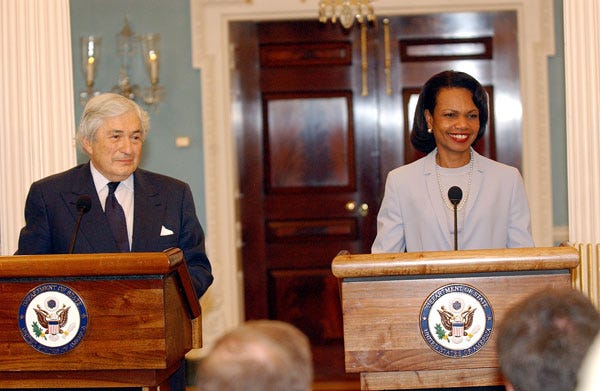
You can read the document here; I will point out what struck me while reading it.
Israel’s Unilaterial Disengagement but Trilateral Coordination
Firstly, the 2005 Israeli withdrawal from Gaza is always referred to as a unilateral disengagement. While Israel’s decision was taken without a negotiated agreement, we see in this document, that it was carried out in coordination with the PA and the United States. Wolfensohn’s task, Rice said:
. . . was to assist the Palestinians and the Israelis in a coordinated withdrawal of Israel military forces and settlers from Gaza.
Then:
That has taken place and taken place successfully, despite all the difficulty that was associated with it. . . . and that is in no small part thanks to the tireless efforts of Jim Wolfensohn who worked day and night to make certain that that could happen.
Israeli Occupation of Gaza
Whatever arguments would later be made about Gaza’s legal status, in May 2006 the U.S. secretary of state described the situation unequivocally:
And in fact, the Israelis do not any longer occupy Gaza; it is Palestinian territory. . .
And, the withdrawal, while not following a ceremoniously signed “peace deal,” was followed up by AMA, a PA-Israel agreement brokered by the United States. The agreement detailed the vision of a prosperous Gaza that would promote a healthy Gazan society.
Following the Election of Hamas
In the key passage in his explanation for resigning, Wolfensohn says that Hamas’s election victory made it “a very difficult moment” to negotiate arrangements affecting Gaza and the West Bank:
. . . because of the emphasis that Hamas puts on the destruction of the state of Israel and the less than communicative relationship with that state [Israel].
Rice responded to a question about working with Hamas:
We continue to hope that Hamas will take the will of the international community seriously and set the minimum conditions for engagement with a partner that the Quartet has laid out. And if those political conditions can come into place, then perhaps we can move forward. [Emphasis added]
She did not see the point in appointing a replacement for Wolfensohn given that the political conditions did not allow moving forward with the plans.
Then she mentioned American efforts to get humanitarian aid to the Gazan population who are suffering. Wolfensohn warned against economically punishing ordinary Palestinians, calling starving Palestinians or taking children out of school “a losing gambit.” But, he continued:
I think the Palestinians need to understand and to accept that the future has to be one where the issues, however difficult, need to be resolved, but that you don’t start by telling the other side that you’re going to shoot them.
The final question addressed to Secretary Rice was about concern for the humanitarian crisis. She responded:
It can’t be business as usual.
“The goal,” she went on, must be for “everyone to send as strong a message as possible to Hamas” that the interests of the Palestinian people are served “by a peace process and a constructive engagement with their Israeli neighbor.”
She ended with:
. . . you can’t have that kind of relationship if you don’t believe in the right of the other party to exist.
That was in 2006.
Now an international Board of Peace is tasked with making work what failed two decades ago.
Just as this article was being finalised for publication, the Israeli cabinet approved the Board of Peace’s pilot project in Rafah, allowing the first phase of the new international initiative to proceed. This makes James Wolfensohn’s remarks from May 2006 more than a historical curiosity.
Of course, the situation today is not identical to that of 2006. Hamas has been severely weakened militarily, a broader international coalition has been formed than twenty years ago, and today’s reconstruction proposals rest on different diplomatic arrangements. However, given Wolfensohn’s experience, is it reasonable for the new international body to invest its time, money, and effort in rebuilding Gaza economically and institutionally, as it sought to do two decades ago, without first resolving the question of who governs Gaza and that governing authority’s relationship with Israel? Or do they believe that economic success in one part of Gaza can lay the political foundations that Wolfensohn concluded were a necessary first step?
Substack’s payment system is not currently operational for writers in Israel. If you want to support this work, you can do so directly via PayPal/Buy me a Coffee,
or Ko-fi. I appreciate both one-time repeated donations to my writer’s fund.
Reader support keeps this work sustainable.
My family and I survived the terrorist bombing season in Israel for 2 years from 1994-1996. If Israelis disarm, there will be no more Israel. If Palestinians disarm, there will be peace.
Good money after bad. Laughable. You can hear the planners when reality hits them in the face, as it inevitably will: Why won't those Arabs listen to what's good for them?