
Numbers vs Morals? Numbers and Morals? Part II: Hostage Deals
Can we accommodate cold arithmetic calculations with a moral stand?

You cannot not go crazy when you look into this at any depth.
In Part I, I provided an introduction to one way to reflect on the morality of exchanging 33 hostages being held by Hamas in Gaza for 734 terrorists, many of whom committed horrific murders (but not including Oct 7th nukhba prisoners). There, I discussed how that approach can help us understand the decision to conduct a ground invasion to try to rescue our hostages and eliminate Hamas as opposed to carpet bombing Gaza. Here I will assess the so-called hostage “deal” in view of the trolley car thought experiment that lies at the basis of this approach.
Briefly recapping, this illustration, from an article explaining the dilemma, presents the problem in its simplest terms, as shown in Part I: a bystander notices a runaway trolley flying down a steep hill; it will kill five people on the track if left alone and only one person if the bystander flips the switch to change the track on which the trolley runs. What would you answer if you were asked what the bystander should do?
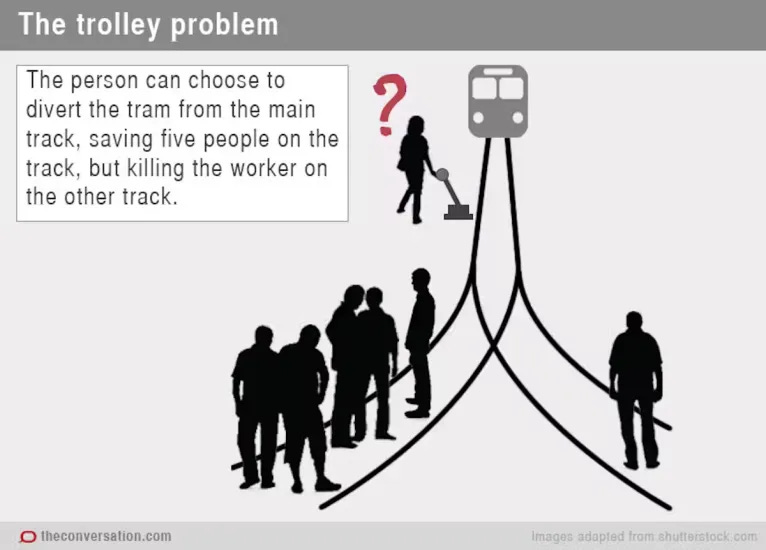
Most people who participated in the research decided to flip the switch.
Why? The simplest explanation is likely the most accurate; while some studies tried to put this into ethical/psychological/philosophical terms, it is most probably simply because it seems right to keep the five people alive over the one.
But let us complicate that a bit: suppose the one on the right is a trolley worker who has been warned about the dangers of the work and knows he may be at risk while the five are random people who shouldn’t be on the track but are; suppose the one on the right is the bystander’s child or best friend; suppose that the one is a pregnant woman or the five are pregnant women. Perhaps the leader of a country (and bystander does not hate him or her) is the one or among the five. In other words, elements such as age, gender, relationships play a part in deciding whether or not to save five or one.
But I want to bring in a more clearly moral aspect to the problem: suppose there is a third track and this track brings the trolley down onto the bystander herself (for simplicity sake, I will make the examples either male or female). If the bystander is not willing to sacrifice herself for the sake of the five, then it is morally untenable that she would sacrifice the one, who likely also does not want to die that day. In other words, the only moral thing she can do in this case would be to do nothing and LET the five die instead of actively KILLING the one as a supposed ‘good deed.’ (I doubt anyone could make a viable case for her killing herself instead of the five if all others were strangers to her unless she was terminally ill and about to die anyway.)
And here we note the difference between letting someone die versus killing someone. (A more detailed discussion of this and other variations can be found in Thomson’s chapter on this subject.)
Back to Israel
In Part I, we noted that the Oct 8th question our leaders needed answer was: do they let the hostages in Gaza perish by attacking from the air and bringing Hamas and other terrorist groups to their knees or do they try to rescue them and risk the lives of the soldiers conducting the ground invasion? Hostages on one track and soldiers on the other.
There was a third track I did not discuss then — the one Israel has used for too long: drop a few rockets on a few military targets and call it a day. But Hamas had set the trolley on its downhill spin in a way Israel had never before experienced and the extraordinary events of Oct 7th required extraordinary acts that would prevent them from doing it again. So our leaders sent the army into Gaza.
And one month later, Hamas released 105 hostages in exchange for 240 terrorists being held in Israeli prisons. Given Israel’s historic hostage-terrorist ratios, this was a pretty good “ransom.” I think that our soldier’s determination and professionalism can be credited for this.
We will leave for another time or another analyst to examine why the equation has changed and our leaders now had to accept an extortion “deal” and exchange 33 hostages for 734 terrorists. Instead, we will just look at the nature of this exchange and any future ones our government may have to consider.
The current hostage “deal”
I am attempting to clarify the issues facing our leaders — not the hostage families, not the families devastated by murders committed by those terrorists who will receive get-out-of-jail-free cards, not the bereaved families of fallen soldiers, not the demonstrators in favour or opposed to the “deal” — but the leaders, the ones who have to decide on a course of action and sign on the dotted line.
Everyone else is a bystander, a witness; Israeli citizens are bystanders with a vested interest in the outcome since the impact of our leaders’ decisions is felt even if we are not directly personally affected. But even having a vested interest does not give us the weighty responsibility of having to make the decisions nor the back-stage knowledge the decisionmakers have.
Who are on the tracks?
The most important part of this exercise is to determine who is on each of the tracks. Is it the hostages on one track and the future victims of the terrorists we release on the other track where we saw that, based on experience from previous hostage-terrorist exchanges, that there is a likelihood that for each hostage saved today, ten Israelis (or more) will be killed in future. This sounds like it might be the same as five people on one trolley track versus one on the other. Put that way, it may seem clear that the moral decision is to favour the ten over the one.
But we need to pay attention to how we contexualize this. It is not hostages versus future victims. It is not the hostages whose faces we can see and whose parents we can hug in Hostages Square versus the victims we need to imagine embracing in the future.
Remember, the motto about Gilad Shalit? How he is everybody’s son, everybody’s brother.
This is heavily ingrained within the Israeli consciousness, perhaps Jewish consciousness. The saying is: כל ישראל ערבים זה בזה (Kol Yisrael Aravim ze b’ze) and in English that is: All of Israel are responsible for each other.
That means ALL OF US. It is not hostage families and their supporters who want a ceasefire and deal at any price versus hostage families, bereaved families of soldiers, and their supporters who want us to continue fighting to the finish. It is hostage families who want a deal now and hostage families and bereaved families who do not. Both/and. Not either/or.
Those opposed to the deal (including me, until now) come down hard on the government for consigning us to the future terrorist attacks that will be carried out by the vile murderers we let out of prison. They argue that this deal risks the safety of Israelis inside Israel and travelling outside Israel, incentivising kidnapping by giving in to the jihadists. It probably will.
Perhaps getting hostages out now at the expense of potential-almost-certain future abductions and murders is consistent with the Israeli penchant for saying: “we will cross that bridge when we reach it.” But I also think now, after having worked through this trolley car experiment, that agreeing to give up the terrorists is the more moral choice given all the circumstances involved. (That leaves me still unhappy about the other sections of the agreement we were compelled to sign but I will leave that for another day.)
And as my daughter, Tali, reminded me in a conversation last night, those 734 we release from prison in this deal are only 734 that we know about. How many others are out there planning and preparing for another Oct 7th and did not need this hostage deal to convince them they must try? Was there a “Sinwar” among the population who would have planned Oct 7th if the real Sinwar had remained in prison? After all, former Israeli Arab MK Haneen Zoabi told us (in English - listen to her voice):
It’s not Hamas who is resisting. It is the Palestinian people.
And yes, you cannot differentiate between Hamas and the Palestinian people. You cannot differentiate between them. Those who entered on the seventh of October—they didn’t enter the Israeli borders. They entered their own land. They entered to their own land. This is their land.
Perhaps it is most appropriate to see that on one trolley track are the hostages and on the other track is destruction of Hamas and the other jihadi groups in Gaza. Our leaders may have believed that it would be possible to accomplish both as if they were on a single track and, until after the first hostage “deal,” it really did seem possible. But then the tracks diverged and spread ever farther apart. And that is what we have to deal with from this point on.
So here is my final take on this issue (for now, anyway)
There are many thoughts, conflicting thoughts, driving me crazy right now but I will be very brief now.
Jihadists abducted and massacred Israelis and foreign visitors for two reasons: (1) that is their nature and their goal; and (2) our leaders turned a blind eye to them. Because our leaders are responsible for ignoring the threats, it is their responsibility to get back as many hostages as possible and to change their way of viewing our enemies and protecting us from them.
When I began writing this article, I thought I was going to support the idea that it is morally more correct to choose the collective good and the ten potential future victims per each current hostage. I ended up convincing myself of the opposite. I am not sure I will say the same when I look at the other parts of what we agreed to — such as leaving parts of Gaza and sending in aid to those who want to kill us.
Whichever way you look there is pain — there is the pain of the hostage families who want their family members home now, there is the pain of the hostage families who fear the deal may leave their loved ones in Gaza forever and who, along with bereaved families of fallen soldiers want the fighting to continue unabated, and there is the pain of the survivors and families of previous terrorist atrocities who are going to see their perps set free. And I have nothing intelligent to say about that — I can only feel it.
Because Israel is not supported on the Substack payment platform, I have set up an alternative for those who want to support my work.

You can make one-time or repeated donations in your own currency using Paypal (Buy me a Coffee, above) or the Ko-fi payment platform here. Israelis can send me a private message for another option.
Articles will always be free for all subscribers but a one-time or repeated donation is a way to help me sustain myself while doing all the work involved in putting these articles together and would be greatly appreciated.
Thank-you to all those who have supported my work by subscribing and/or by donating coffees.
I think that the first “deal” has been done when Israel has been attacking gaza with all its might, when all these shameful “world leaders” were still under impression of 7of October and so hamas was scared of what is coming. But shortly after that America and other western countries started to blackmail and threaten Israel. And to continue fighting Israel had to partly bend under their pressure and use only one hand instead of two. I am sure that everything would be different if only all these western countries cracked down on hamas, on all these despicable so called demonstrations and campuses Jew hatred and stood firmly for Israel.
Also I believe that all these demonstrations in Israel on Kaplan with their demands “deal for any price” added to this distress - my impression is that organisers of these protests have hostages blood on their hands! They gave gazans the cart blanch to keep hostages. These organisers used pain, horror and desperations of hostage’s relatives to manipulate them and with only one and one purpose - to get rid of Bibi and his government. It is sooo shameful and unforgivable!
I would exile all these activists from Israel!
I am very divided with this extortion now, my heart goes for hostages and their relatives and my heart goes for Israel in general. I cannot decide.
It seems to me that the real question is, how can Israel prevent this all happening again in the future? The taking of hostages and the moral imperative to save them has become Israel's Achiles Heel in light of Israel's willingness to exchange jailed terrorists for their release. If anti-Jewish terrorism was to become a capital offence in Israel punishable by death, that might conceivably change the equation and hostage taking itself might become a much less attractive proposition to the terrorist factions.