

By the time the Jab’a incident entered the international news cycle, its contours already seemed fixed. Headlines spoke of a pogrom. Reports described dozens, and in some accounts even hundreds,, of settlers rampaging through the village, setting homes ablaze while families hid inside. These descriptions circulated quickly and widely, crossing languages, platforms, and political contexts with remarkable consistency.
This article asks a narrower question. What does the publicly available physical record actually show?
Not what witnesses experienced. Not what attackers may have intended. Not what moral judgments the incident deserves. Only what the images and videos themselves can independently support.
Across the Jab’a series, I have traced how claims were introduced, amplified, and stabilised. Part 1 examined how captions framed meaning before evidence was examined. Part 2 showed how Arabic-language media expanded scope and scale without adding documentation. Part 3 mapped contradictions and amplifications across NGO timelines. Part 4 compared NGO labelling of Jab’a as a pogrom versus their mild labelling of Oct 7th. Part 5 turns to the material record itself.
Testimony and physical corroboration
One resident is repeatedly quoted across media reports as a primary witness. His testimony describes attackers entering the home and attempting to set it on fire.
Testimony documents lived experience. When testimony concerns physical processes like fires and structural damage, it requires physical corroboration.
The publicly available images associated with the house he identifies as his son’s do not show evidence of interior fire damage. The images commonly circulated from this location consistently depict exterior damage and a burning vehicle in the compound. They do not document fire inside living spaces.
This discrepancy does not negate the testimony. It defines its evidentiary limits, as we will see in the following analysis.
The visual record carrying the narrative weight
The publicly available visual material related to Jab’a is surprisingly narrow given the scale of claims made (linked sources are all provided in the Appendix to Part 3). A small number of videos and photographs appear repeatedly across NGO posts, media reports, and activist accounts. These visuals carry most of the narrative weight.
A residential compound where a van was filmed burning at night from an elevated balcony comprises one site. The balcony video is the most widely circulated image of the incident and is repeatedly used when implying attempted arson of an inhabited home. Here it is as broadcast by i24 News. I do not have the original recording.
A separate CCTV video, filmed elsewhere in the village, and first shared by B’Tselem, shows a stoned vehicle and one that was torched.
Public reporting often refers to “multiple sites” without specifying how many. Based on the visual record alone, only these two distinct locations can be identified.
Architectural comparison and site identification
With the assistance of OSINT analyst Tal Hagin, indicators were compared across night-time and daytime imagery. This placed the balcony, from which the video was shot, in the compound later visited by NGO activists and claimed to be the site of attempts to set fire to the home with the family inside. The indicators include the distinctive iron banister design with a pronounced mid-bar bulge, balcony geometry, window placement, spatial relationships between the building and the courtyard, and evidence from images taken from other angles.
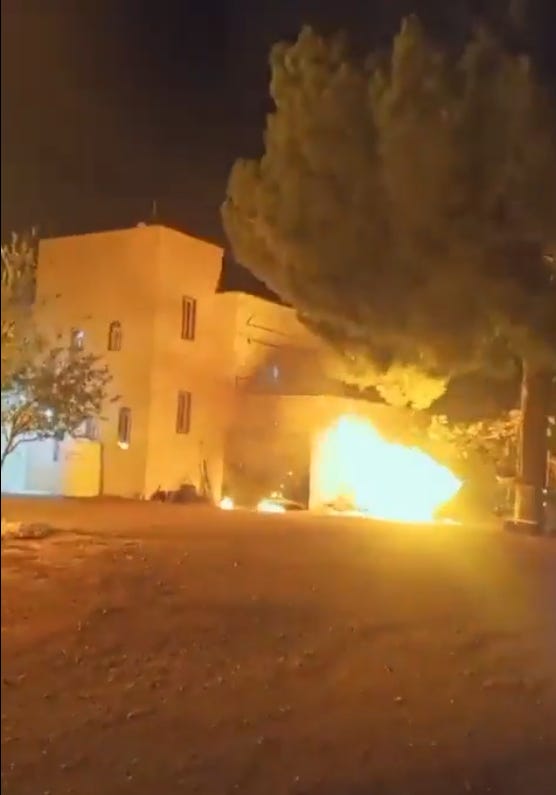
The B’Tselem footage shows a metal frame that protrudes from the parking garage, distinguishing it from the garage next to the house in the balcony video site.
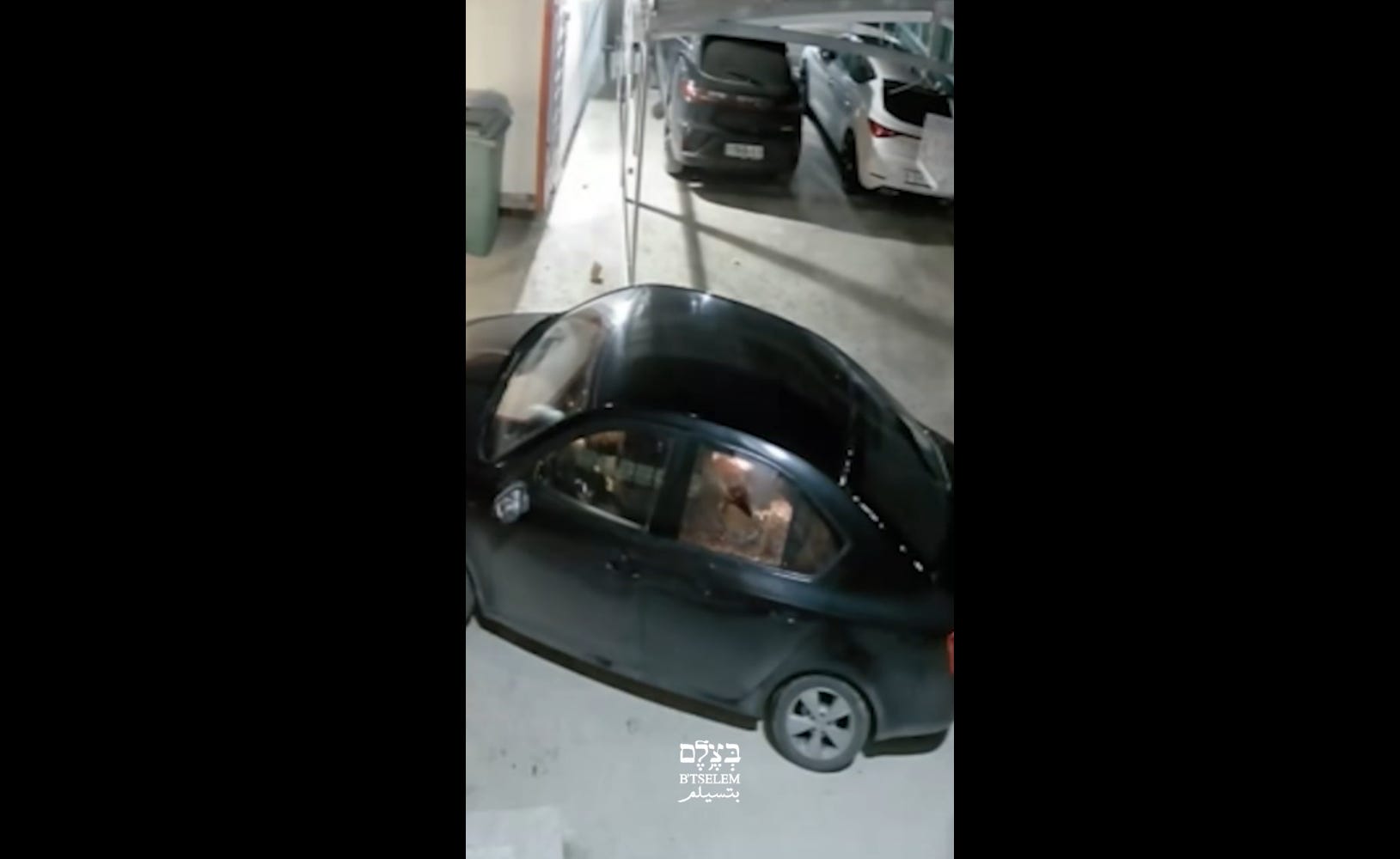
Repeated use of imagery from the same structures across different reports creates the impression of multiple affected homes when, in fact, the visuals cluster around two locations. Additional sites may exist but are not independently documented in the publicly released visual record.
Vehicles: what can be independently verified
Across the available footage, four vehicles were independently identified and consistently documented in the NGO and mainstream media reports. These are: the burned van in the balcony video and later used as a prop in NGO day-after photos, the burned car in that same compound, two cars in the B’Tselem video, one damaged by stones and the other torched.
These four vehicles meet basic verification criteria. Each can be located within a specific site and in video footage from that night. Each appears in more than one frame or angle. Each is associated with fixed architectural markers allowing placement in space.
In addition to these four vehicles, images show a further car at the balcony-video site with impact damage from a cement block thrown through its rear window. The available footage does not establish when that damage occurred or whether it resulted from the same incident. Only one photo, taken at an angle that showed its location relative to the house, even allowed placing it there at all.
Additional images of burned vehicles circulated online but cannot be tied to these locations through overlapping angles, architectural markers, or timestamps. Without corroborating footage, they cannot be reliably linked to Jab’a at all. Excluding them is not a judgment about authenticity but a methodological requirement.
The claim of interior arson
The balcony video shows a van burning in a residential compound at night. Flames illuminate the courtyard and nearby walls. This footage is repeatedly paired with claims that settlers attempted to burn homes with families inside. +972 Magazine published testimony describing the direct use of accelerants inside a living space. That account is not corroborated by the available physical documentation.
The question is not whether the fire was frightening or dangerous. It clearly was. The question is whether the publicly available physical record documents an attempt to ignite the interior of the home.
In enclosed residential fires, interior ignition or near-entry ignition typically leaves specific signatures. These include directional soot deposition on interior surfaces, heat warping of nearby fixtures, secondary ignition of adjacent materials, and smoke migration patterns into ceiling corners, wall junctions, and ventilation pathways. Even an unsuccessful attempt involving an incendiary device entering or igniting near an interior opening would ordinarily leave some trace.
In images and videos made public, these indicators are absent.
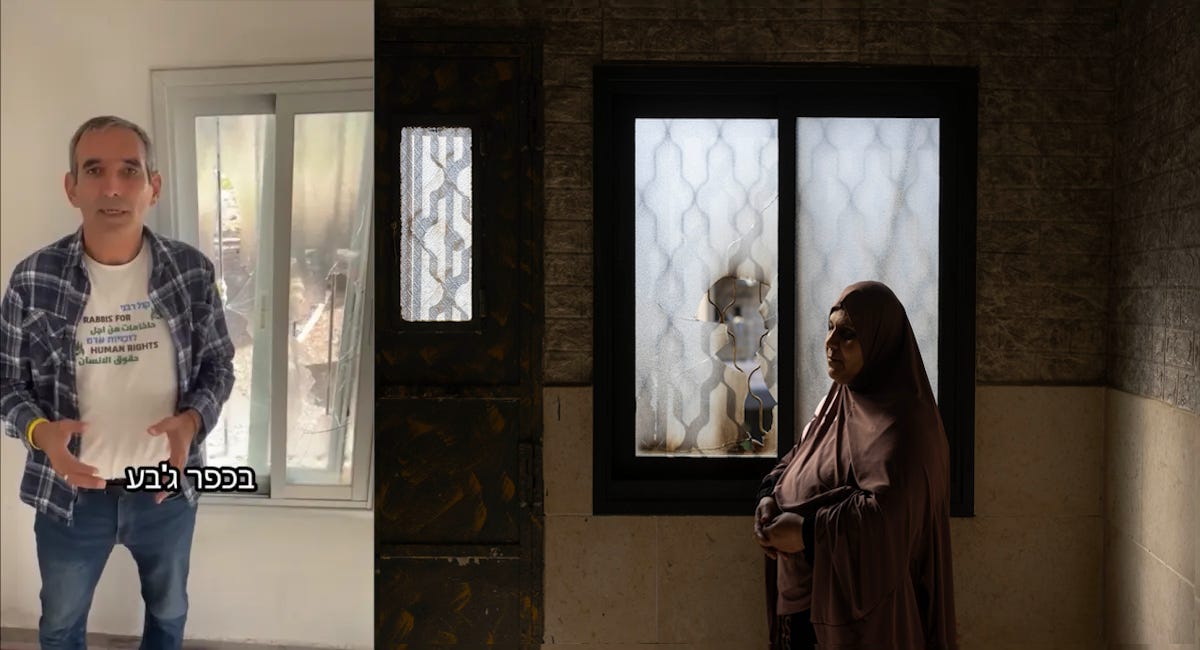
The windows are broken, but glass fracture alone does not support interior ignition. The metal bars are intact and unwarped. Interior walls and ceilings do not show soot stains consistent with an internal fire. The window frames do not exhibit melting or deformation patterns associated with internal combustion.
Some reporting illustrates claims of attempted interior arson with images showing smoke staining on exterior walls. Exterior soot deposition indicates proximity to fire, not fire entry. It does not document ignition inside a living space, nor does it substitute for interior fire signatures or even if these stains were made on the day of the attack.
None of this means that ignition inside homes was impossible. It means that the physical record does not demonstrate it.
What the physical record does suggest
From the publicly available material, it can be confirmed that there were ignition events at two distinct locations in Jab’a. Four vehicles were damaged, three by fire. The proximity of the fires to the two homes was frightening but did not spread to the homes themselves.
These findings establish an evidentiary ceiling beyond which claims are not supported.
The lack of verification
One of the most striking aspects of the Jab’a coverage is not exaggeration by activists or NGOs. It is the abandonment of field verification by domestic media.
Israeli outlets repeated claims without evident on-site verification: no independent identification of locations, no confirmation of damage patterns, and no reconciliation of internal inconsistencies. In one case, daytime footage of a vehicle actively burning was repeatedly interspersed with the balcony video and images of an exterior fire in the same compound, despite clear temporal incompatibility.
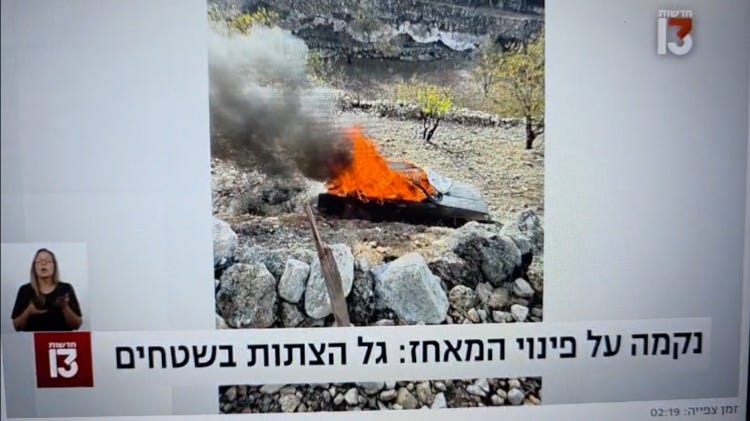
This constitutes narrative inertia: Once the frame was established, verification became “optional.” This aspect will be examined in the next article in this series.
Why this matters
Claims about incidents like Jab’a are routinely used to define broad patterns of settler violence. That makes evidentiary precision especially important.
The Jab’a incident involved violence, fire, and fear for those present. None of that is in dispute. What is in dispute is whether the claims made about it are anchored to what could be shown.
Physical evidence does not resolve narrative disputes. It constrains them.
That constraint was absent here.
Consider becoming a donor to support the research, the interviews, the argument that goes into my independent investigative reporting.
Because Substack does not process payments in Israel, I’ve set up [PayPal/Buy Me a Coffee] and [Ko-fi] for anyone who’d like to support my work. Every bit of help means a lot and actually helps me continue to do the research and write. You can make a one-time or repeated donation.
Thank you.
p.s. It’s not because of antisemitism on the part of Stripe or Substack.
Fantastic work on the forensic methodology here. The distinction between exterior soot deposition and actual interior ignition signatures is somthing a lot of reporting glosses over. I've seen similar gaps in wildfire coverage where proximity damage gets conflated with direct fire intrusion, and the material evidence just doesnt support the broader claims being made.
Excellent reporting and analysis. 👍